L-Type Gantry Cranes for Nigeria

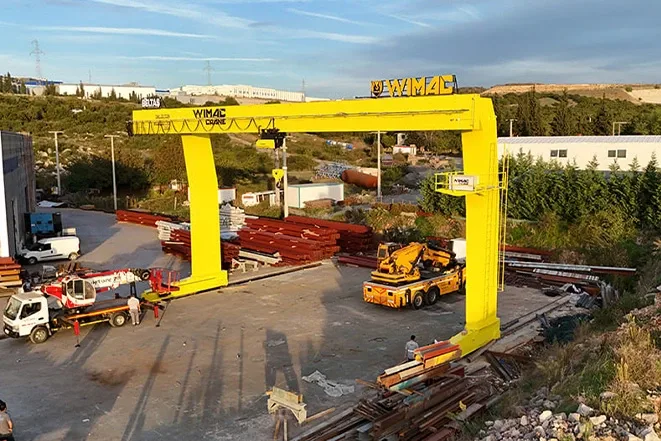
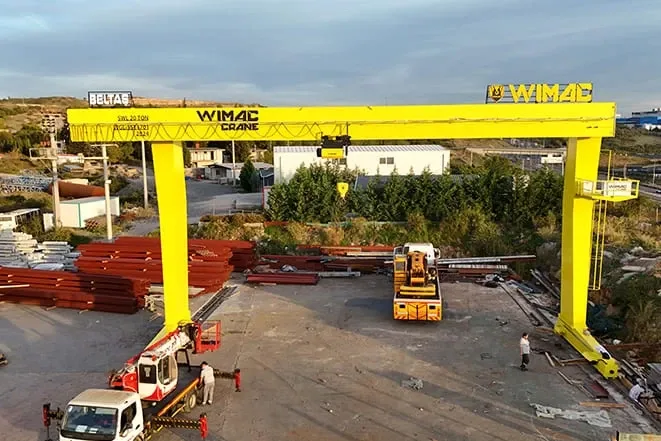
Where a yard has room for only one ground rail, an asymmetric L-type gantry crane does the job. Wimac fabricates these single-leg portals in Konya, Turkey and supplies them to Nigerian ports, steel yards and fabrication sites from Lagos to Port Harcourt.

Inside an L-Type Gantry Crane: Key Parts Explained

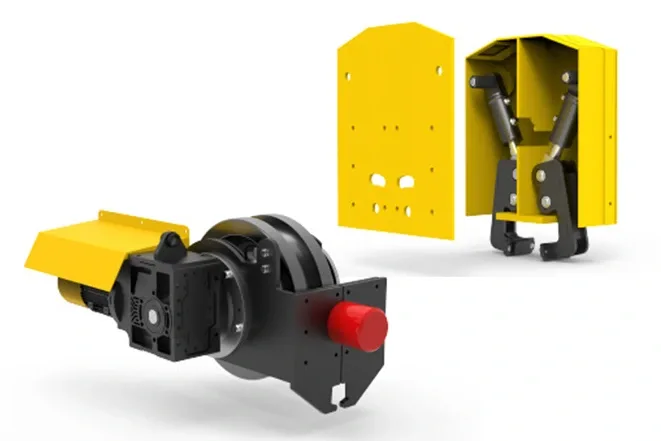
Clickable parts diagram of a Wimac L-type gantry crane marking the hoist, end carriage, leg joint and festoon
01
Introduction L-Type Gantry Crane

How an L-Type Gantry Crane Works

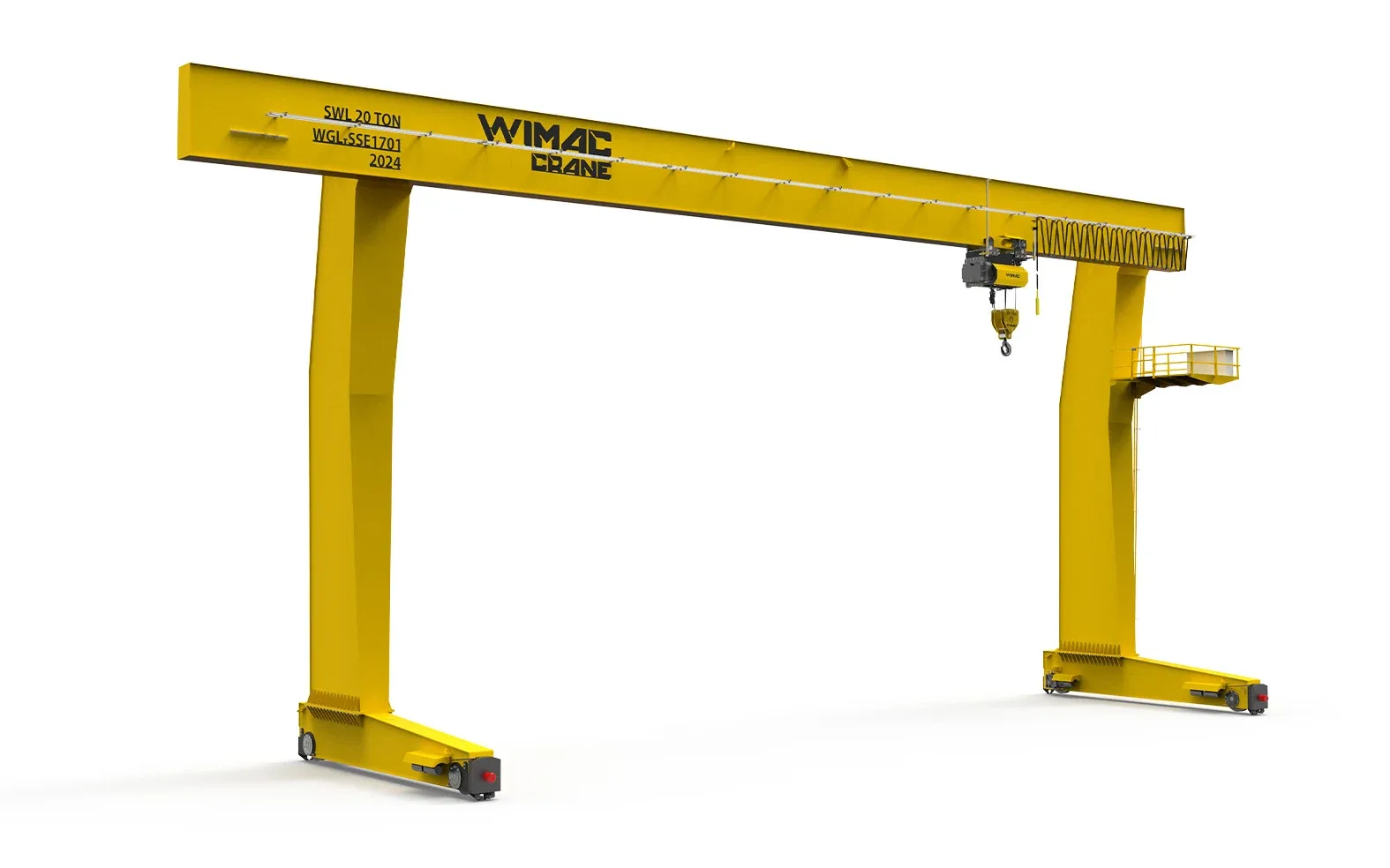
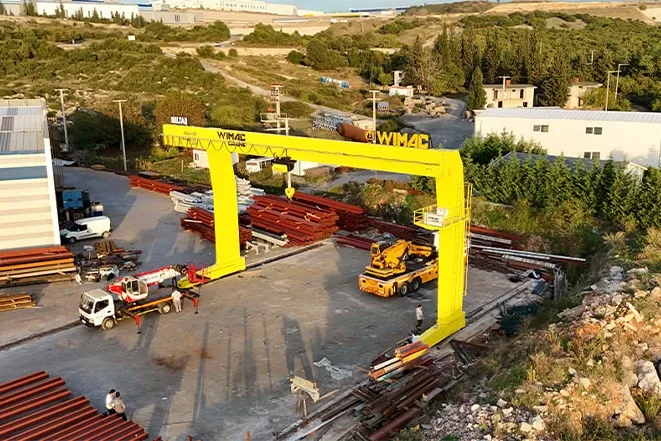
An L-Type Gantry Crane — you may also hear it called an asymmetric portal crane or a goliath crane — stands on a single vertical leg on one side, while the other end of the girder reaches out over the working area. That layout is built for moving heavy, awkward loads out in the open. Wimac manufactures every unit at its plant in Konya, Turkey, then ships, installs and supports it for customers throughout Nigeria. Because the frame is half-open, leaves generous clearance beside the leg and manoeuvres easily, it suits cramped yards, logistics areas and big construction jobs alike. It pairs a strong, safe structure with comfortable operation, so it keeps working in tough, demanding site conditions.
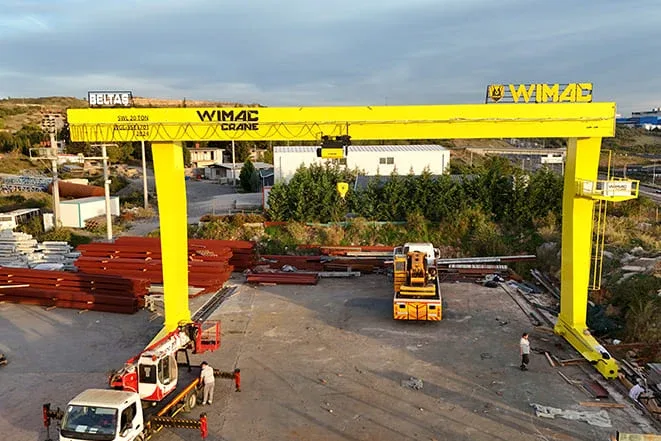
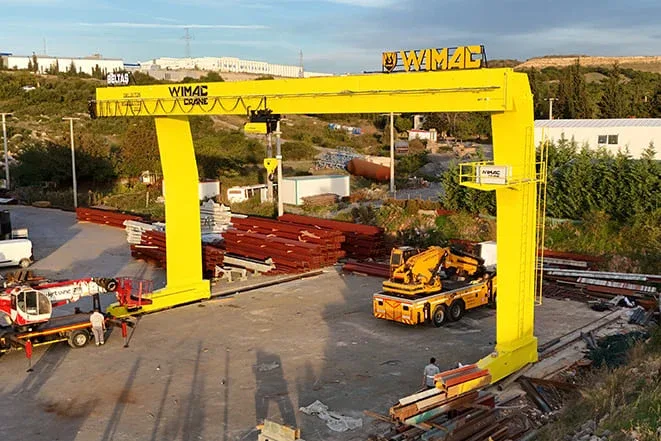
You will find L-Type Gantry Cranes in steel fabrication shops, on construction sites, in yards stacking pipes and beams, in heavy-plant storage areas, at shipyards and ports, at railway loading points and across wind and energy projects. Those same settings are everywhere in Nigeria — from the port terminals at Apapa, Tin Can Island and Onne to pipe and fabrication yards in the Niger Delta and the manufacturing estates of Ogun State.

Less Wind Load

With only one leg, the frame presents a smaller face to the wind, which also helps cut energy use.

Open Side for Trucks

Lorries and long materials can be driven or laid straight into position from the open side.
L-Type Gantry Cranes in Nigeria: Your Questions

Straight answers for Nigerian buyers comparing asymmetric gantry cranes — why the single-leg layout helps, how much it lifts, which spans are possible and where it earns its keep.

What exactly is an L-type gantry crane?
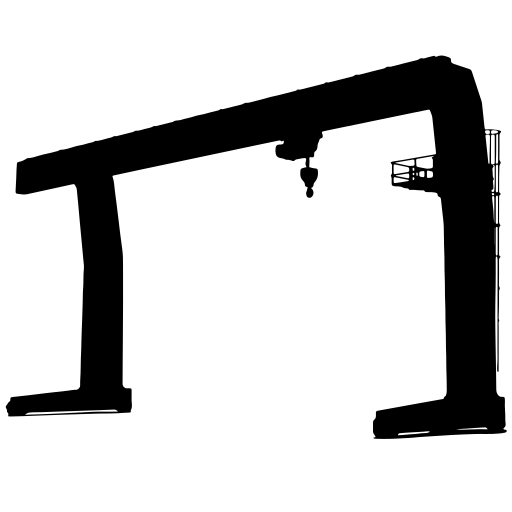
It is a portal crane built asymmetrically, so seen from the end it looks like the letter "L". A single upright leg with wheels at its foot carries one end of the girder, and the other end projects outwards as a cantilever. Because there is no second leg, there is also no second runway rail on the ground — that strip of floor stays free for production lines, roadways or stacked material.
Why choose the L-type layout over a full portal?
You lay one ground runway instead of two. That opens up one side of the lifting area completely, reduces the civil works budget and lets the crane reach across roads, conveyors or machinery already in place. For the same span, the bridge is also lighter than that of a full double-leg portal.
In which situations is an L-type gantry the right fit?
It makes most sense when one side of the work zone must stay open: lorry loading bays, precast yards, rail sidings or factory aisles where a second floor rail would get in the way of traffic. It is equally useful where a building wall or an existing row of columns already occupies one side.
How much can an L-type gantry crane lift?
The standard Wimac L-type range runs from 1 t to 100 t. Heavier cranes can be engineered as a dedicated project, depending on the span and how long the cantilever arm needs to be.
Which FEM / ISO duty classes and spans can you offer?
Most Wimac L-type cranes are designed within FEM 1Am to 4m / ISO M4 to M8. Spans reach 30 m and cantilever arms reach 10 m. Our general information and selection guide sets out the full FEM / ISO reference.
What kinds of sites use L-type gantry cranes?
Common users are precast and concrete yards, steel stockyards, shipyard fitting-out bays, container loading areas, railway workshops and any open or partly covered site where access from one side is preferred. The design is also applied to outdoor handling in process crane service at steel mills.
Can Wimac supply an L-type gantry crane to my site in Nigeria?
Yes. Each crane is manufactured at the Wimac factory in Konya, Turkey and then supplied, installed and serviced for customers across Nigeria — whether the site is a port terminal in Lagos or Onne, a fabrication yard around Port Harcourt or Warri, or a plant in Ogun State, Abuja or Kano.
What details should I send to get a quotation?
Tell us the heaviest load, the span you need, the required lifting height and cantilever length, how many hours a day the crane will work, whether it runs indoors or outdoors, and the site location in Nigeria. A simple yard sketch or site photos help our engineers size the crane accurately.