


Crane Hook Blocks for Nigeria
Everything a crane lifts hangs from its hook, which is why Wimac treats the crane hook block as a safety-critical component built for strength and dependable service. Our hook blocks follow FEM, DIN and ISO standards and are made to keep performing through years of hard industrial use. A complete assembly combines a forged steel hook, precision sheaves, anti-friction bearings and heavy steel side plates. We manufacture them in Konya, Turkey and ship them to Nigeria in two ways: fitted to new Wimac cranes, or as replacement spare parts for cranes already at work in factories, yards and plants from Lagos to Port Harcourt.
Types of Crane Hook Block Available in Nigeria
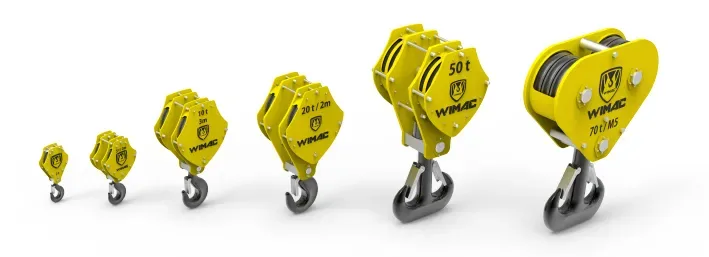
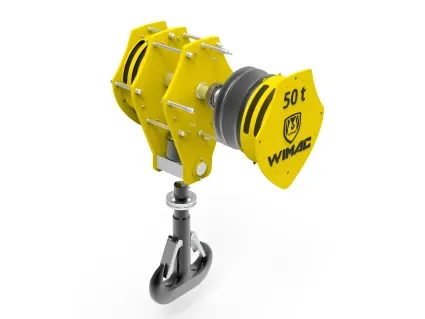
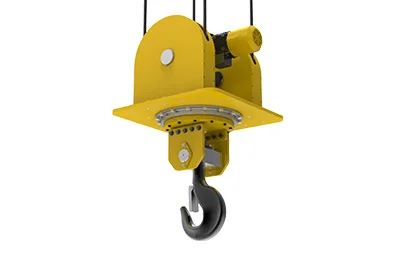
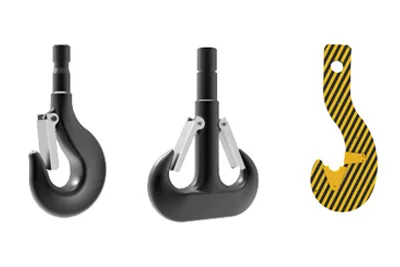
Different lifts call for different hooks, so the range includes single hooks for everyday lifting, double hooks that share the load evenly across two points, laminated hooks for the heaviest-duty work, and rotating hooks where the load must be turned and placed accurately. Whichever type you need, hook blocks can be supplied for capacities between 1 ton and 500 tons.

Hook Steel, 5:1 Safety Factor and Design Standards
Each hook is forged from DIN Class P fine-grained carbon steel (S355J2), a material chosen for its strength, toughness and consistent behaviour in heavy industrial service. A design factor (safety factor) of 5:1 gives a wide margin of operating safety, and every hook comes with a safety latch so the sling cannot slip off and release the load by accident.
Choosing a Hook by 'P' Class
Use the table below to select the hook 'P' class. Read across from the load to the column that matches how many lifting operations the crane makes each hour and how long it works at each load level — up to 6, 6–18, 18–30, 30–60, or more than 60 operations.
| Lifting Operations per Hour | Up to 6(M3/1Bm) | 6 to 18(M4/1Am) | 18 to 30(M5/2m) | 30 to 60(M6/3m) | Over 60(M7/4m) |
|---|---|---|---|---|---|
| 1600 | 1 | 1 | 1 | 1,6 | 1,6 |
| 2500 | 1 | 1,6 | 1,6 | 2,5 | 2,5 |
| 3200 | 1,6 | 2,5 | 2,5 | 2,5 | 4 |
| 5000 | 2,5 | 2,5 | 4 | 5 | 5 |
| 6300 | 2,5 | 4 | 4 | 5 | 6 |
| 8000 | 4 | 4 | 5 | 6 | 8 |
| 10000 | 4 | 5 | 6 | 8 | 10 |
| 12500 | 5 | 6 | 8 | 10 | 12,5 |
| 16000 | 6 | 8 | 10 | 12 | 16 |
| 20000 | 8 | 10 | 12 | 16 | 20 |
| 25000 | 10 | 12 | 16 | 20 | 25 |
| 32000 | 12 | 16 | 20 | 25 | 32 |
| 40000 | 16 | 20 | 25 | 32 | 40 |
| 50000 | 20 | 25 | 32 | 40 | 50 |
Crane Hooks for Nigerian Industry
Hook blocks wear with every lift, and on busy cranes in steel mills, cement plants, port logistics yards, oil and gas fabrication shops and FMCG warehouses they are among the parts most often inspected and replaced. Wimac supplies complete hook blocks to Nigerian crane owners in Lagos, Ogun State, Port Harcourt, Abuja, Kano and beyond, matched to the hoist, rope reeving and duty class of the crane.