DIN
CE
ISO
FEM
EAC

Each bridge layout covers a different part of the duty range: the cost-effective single girder handles loads up to roughly 20 t, the double girder takes heavy work up to 320 t, and the underslung version keeps headroom free in low buildings.

Two-girder bridge built for heavy, continuous-duty lifting with capacities reaching 320 t.
See Specifications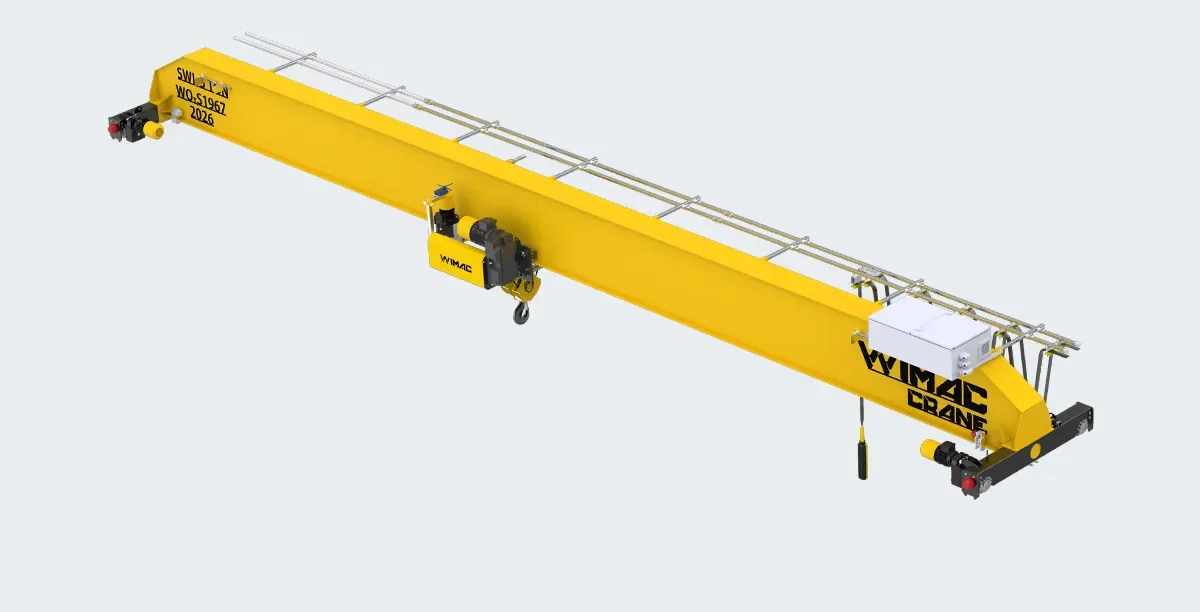
Budget-friendly bridge crane for light and medium industrial duty, up to about 20 t.
See Specifications
An under-running bridge suspended from the runway — the answer for buildings with little headroom.
See SpecificationsSteel rolling mills, power stations, FMCG factories and workshops across Nigeria use overhead cranes every shift. These answers cover the points buyers ask about most before ordering. For budgeting, see what drives an overhead crane price in Nigeria.
A single girder crane carries its hoist under one bridge beam and is the economical choice for light to medium duty up to around 20 t. A double girder crane runs its trolley on top of two girders, giving more hook height and capacities up to 320 t for heavy, continuous duty.
A low ceiling (underslung) crane hangs beneath its runway beams instead of running on top of them, which recovers valuable headroom in buildings with restricted height.
They are engineered and manufactured at the Wimac factory in Konya, Turkey, then shipped to Nigeria, where Wimac supports installation, commissioning and after-sales service.
Send the required capacity, span between the runway rails, lifting height, runway length and the heights from floor to rail and floor to roof. A short note on what you lift and how often helps us choose the right duty class.